Rimbian Life
A vision for life in a post-AI world

I have lived in many places over my first 51 years in this life, and I think I have the answer to how do we live in a post AI world. Some of us will remain in the system, and some will want to opt out.
This manifesto is a living document of how I think they can live.
For centuries, we humans have clustered in cities for two fundamental reasons: community and access to infrastructure. But we need to feed everyone in cities and we have become disconnected with the land. Big companies and unbridled capitalism have met this need but added round-up and shit food that is making us sick, and dependence on the state has grown. We saw where this led in covid times.
We all know this is the wrong direction.
Imagine a future where small, decentralized villages (I am calling them “Rimbian” villages) are built in beautiful, semi-remote areas. There is so much land that can be used, but access is the issue. And that is often the best land. On the edge of wild jungle (Rimba means wild (mystical) jungle in Indonesian). Drones will solve access very soon.
The Rimbian home
Each Rimbian home in the village is a largely self-sufficient micro-farmstead, with organic vegetable gardens, fruit trees and chickens. Ice baths and saunas, mini gyms (these may be centralised to encourage serendipitous interactions).
Health and wellness is the theme of the home and Rimbian life more generally
Whatever residents cannot produce themselves can be delivered by drones. And the AI tells you how to do it, and robots will help. Maybe the farming is communal and / or enabled by robots. The point is as much as you can you grow your own food. You know that it is clean. No glyphosate or other crap.
The Rimbian village
These Rimbian homes are clustered into small Rimbian villages of around 100–150 people (a Bali Banjar is this big, as is a US company; for a reason - it is the number of people that seems to just work), surrounded by nature, with communal things: a clubhouse, a bar, restaurant, comedy club, sports recreational facilities at their heart so you can hang out with the neighbours. Maybe it is a bit like the Shire in LOTR.
I imagine three clusters of around twelve houses, each arranged around a shared gathering space, making a village of about 36 homes in total. With roughly three to four people per household, that would be around 108–144 people. Each cluster could have gardens, paths and places to sit; the village as a whole would share its clubhouse, bar, dining area, workshops and sports facilities.
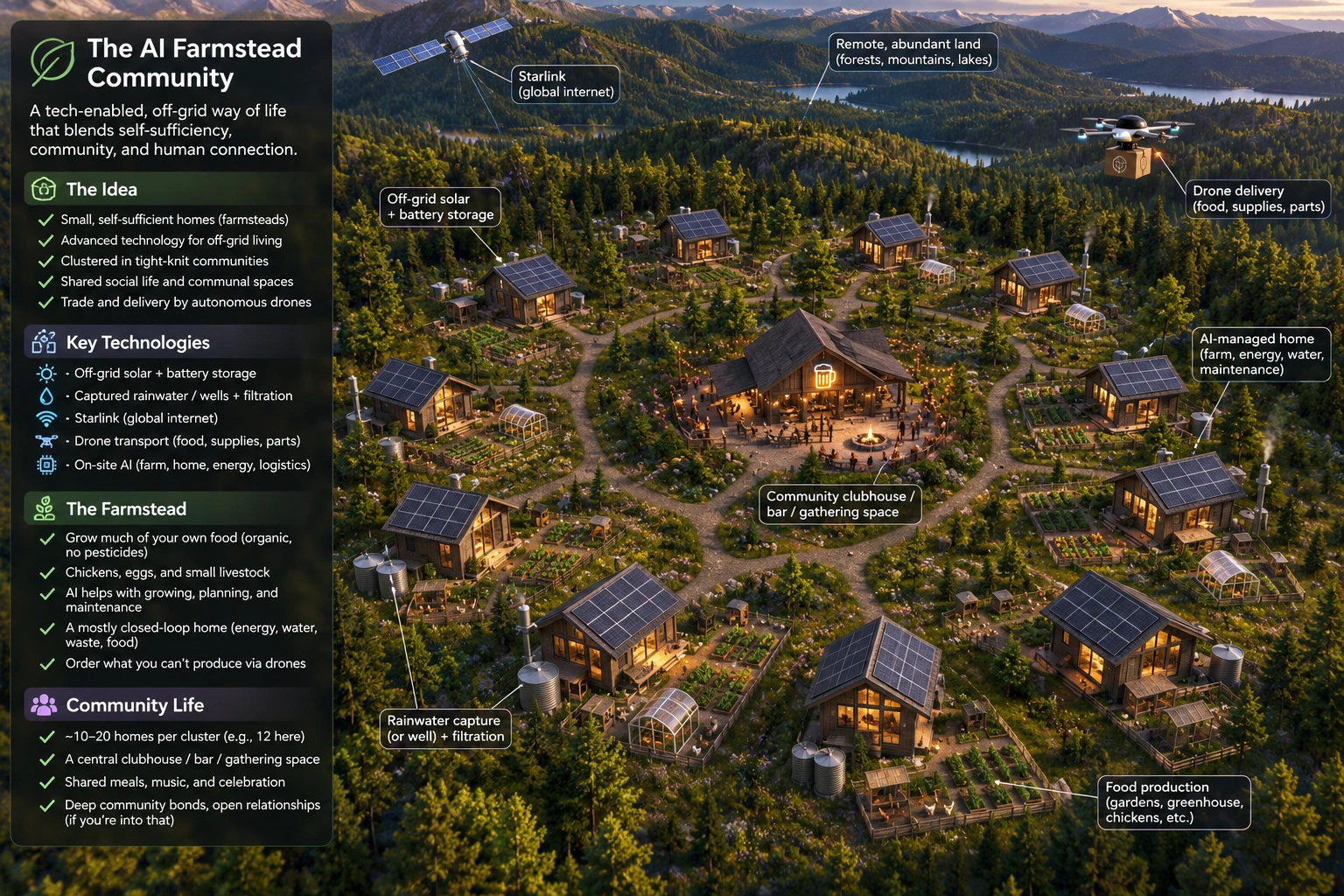
You are not dependent on the state for almost anything and Rimbian villages would be multigenerational and care for the older folks for as long as possible at home.
By design you can have many different cultures and religions living together harmoniously, no homogenous groups drowning out other groups. Singapore does this with their HDBs controlling race ratios. Your tribe and first loyalty is to your village.
Rimbian villages would as much as possible police themselves. In Bali there is the Pecalang (Banjar police) that do this but the community helps too. Crime will be very rare and insurance would be communal
The objective is not isolation but independence without loneliness, combined with resilience. AI enables us to return to village life without sacrificing the conveniences of modern civilisation.
Work
Jobs would centre around making villages more efficient, but there would also be creative work. Farming the communal crops, tending animals and developing new farming or animal-rearing techniques would all be jobs in their own right. Maybe the farming would be enabled by robots.
Other jobs are making the Rimbian AI system better or the drone technology more efficient, working at the micro-nuclear plant, teaching and caring, working in the restaurant, making artisanal furniture or clothes for your own village or other villages. Jobs would be startups with at least 30% employee ownership and rules that CEO salaries are capped to not more than 50x the average lowest salary (I have plenty more ideas of how this would work from my 30+ years in corporates and startups)
Being an artist, musician or comedian would be a highly valued job. People could make art, perform, teach or broadcast their comedy and music to the other villages which would increase demand for visits from those other villages. The value of in person music performances would be high. In person will become highly valued.
You could still work in the ‘big bad city’ or in a cool office with other people if you wanted to, because drone transport could be fast and go from point to point, without traffic.
Inter-village life
You compete with other villages in sports events, satisfying the need for competition (or whatever the reason was for Indians raising neighbouring villages) while encouraging inter-village mingling and dating and inter-village trade.
Each village could have specialities. The comedy village might have comedians and a stand-up venue at the centre; a music village could have a concert hall and an art village could have studios and exhibitions.
Villages could trade the things they make at sports days or online for drone delivery. You could watch performances from another village and then go and visit it. Little schools like Green School would cater for small groups of villages.
You don't have to only live in your village; you can do short or long term house swaps with people in other villages. Cold Rimbian villages in Norway will be different from hot Rimbian villages in Oman.
Technology
The tech didn't exist before but it is getting there.
- Energy independence:
- Off-grid solar power and battery storage, or more likely micro-nuclear.
- Water independence:
- Rainwater harvesting, wells and intelligent water recycling.
- Connectivity:
- Starlink and satellite internet. No cell towers.
- Logistics:
- Drone deliveries reducing dependence on roads and conventional supply chains.
- Decentralized AI:
- Every household has its own local AI computing system, managing energy, water, food production and household operations. You don't share this info with big tech companies.
Who is with me? And what have I missed?